5 lições dos casais da Bíblia sobre como amar na prática
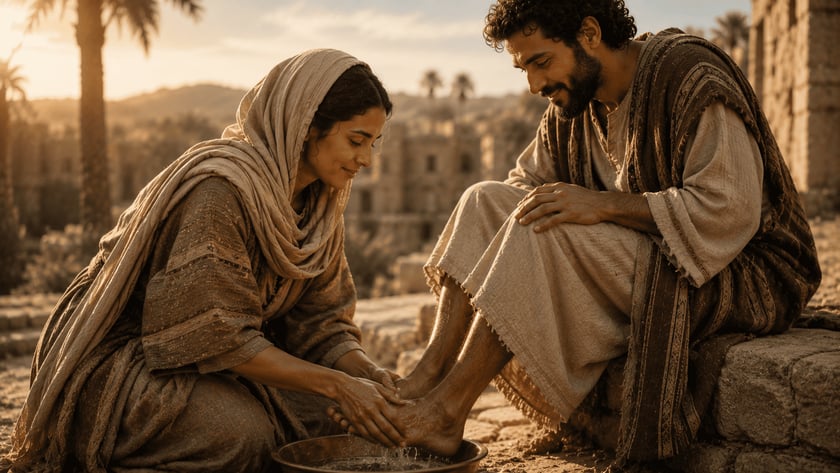
Amor bíblico não é sentimento idealizado; é a decisão diária de cuidar, perdoar e construir uma aliança em meio às pressões da vida real. Ao registrar as crises e os acertos de casais comuns, as Escrituras ensinam como transformar intenções em atitudes concretas no casamento.
1. Acolher a dor em vez de diminuir o sofrimento (Elcana e Ana)
Ana enfrentava a dor da infertilidade em uma cultura onde o valor da mulher estava diretamente atrelado à maternidade. Em vez de cobrar forças da esposa, repreender o choro ou se esquivar da tristeza dela, Elcana demonstrou sensibilidade afetiva e proximidade em 1 Samuel 1:8. Amar na prática significa ser o primeiro abrigo emocional do cônjuge, validando o sofrimento do outro em vez de exigir que ele supere o momento sozinho ou rápido demais.
2. Trabalhar em equipe no sustento e na fé (Priscila e Áquila)
Priscila e Áquila atuavam lado a lado na fabricação de tendas para o sustento e no ensino do evangelho. Em Atos 18:26, o texto registra que os dois acolheram o pregador Apolo e lhe explicaram com mais exatidão o caminho de Deus, sem disputa de protagonismo ou vaidade pessoal. O casamento atinge maturidade quando o casal deixa de competir entre si e passa a agir como uma equipe coordenada, onde a rotina de trabalho e os projetos espirituais são construídos juntos.
And he began to speak boldly in the synagogue: whom when Aquila [an eagle] and Priscilla [ancient] had heard, they took him unto [them], and expounded unto him the way of God-The Father more perfectly.(Acts 18:26)
3. Preservar o afeto em períodos de crise e escassez (Isaque e Rebeca)
A escassez de recursos obrigou Isaque e Rebeca a migrarem para a região de Gerar para sobreviver à fome. Mesmo sob o estresse da adaptação, da instabilidade financeira e do medo, o relato de Gênesis 26:1-8 mostra que os dois mantinham a cumplicidade e a afeição física no cotidiano. Crises econômicas geram ansiedade e desgaste na rotina, mas o casal bíblico lembra que o estresse externo não pode se transformar em agressividade dentro de casa.
And there was a famine in the land, beside the first famine that was in the days of Avraham [exalted father/Fly They Will]. And Yitz’chak [Laughter] went unto Avi-melekh (my father is king) king of the P’lishtim (wanderers) unto G’rar (a lodging place).
And the LORD-Yehōvah (Messiah Pre-Incarnate) appeared unto him, and said, Go not down into Mitzrayim [Egypt] (Double Distress or Double Stronghold, Black Land); dwell in the land which I shall tell youi of:
Sojourn in this land, and I will be with youi, and will bless youi; for unto youi, and unto youri seed, I will give all these countries, and I will perform the oath which I swore unto Avraham [exalted father/Fly They Will] youri father;
And I will make youri seed to multiply as the stars of heaven, and will give unto youri seed all these countries; and in youri seed shall all the nations of the earth be Blessed (Favored by God; happy; prosperous);
Because that Avraham [exalted father/Fly They Will] obeyed my voice, and kept my charge, my commandments, my statutes, and my laws.
And Yitz’chak [Laughter] dwelt in G’rar (a lodging place):
And the men of the place asked [him] of his wife; and he said, She [is] my sister: for he feared to say, [She is] my wife; lest, [said he], the men of the place should kill me for Rivkah (Tied Up; Secured); because she [was] fair to look upon.
And it came to pass, when he had been there a long time, that Avi-melekh (my father is king) king of the P’lishtim (wanderers) looked out at a window, and saw, and, behold, Yitz’chak [Laughter] [was] sporting with Rivkah his wife.(Genesis 26:1-8)
4. Escolher o perdão e o resgate da aliança (Oseias e Gomer)
O texto de Oseias 3:1-3 retrata um dos momentos mais exigentes das Escrituras: o profeta recebe a orientação de resgatar e acolher de volta sua esposa, pagando um preço para reintegrá-la ao lar com dignidade. Sem incentivar a conivência com a destruição contínua do lar, a passagem mostra que o amor bíblico vai além da conveniência e da retribuição imediata. Quando há arrependimento sincero, amar exige a coragem de perdoar, fechar espaço para acusações passadas e recomeçar sobre o compromisso assumido.
Then said the LORD-Yehōvah (Messiah Pre-Incarnate) unto me, Go yet, love a woman beloved of [her] friend, yet an adulteress, according to the love of the LORD-Yehōvah (Messiah Pre-Incarnate) toward the people of Yisra’el [He Holds Onto The Heel Of God], who look to other gods, and love raisin cakes.
So I bought her to me for fifteen [pieces] of silver, and [for] an homer of barley, and an half homer of barley:
And I said unto her, youi shall abide for me many days; youi shall not play the prostitute, and youi shall not be for [another] man: so [will] I also [be] for youi.(Hosea 3:1-3)
5. Manter transparência total nas decisões da casa (Manoá e sua esposa)
Após receber uma instrução sobre o nascimento de Sansão, a esposa de Manoá procurou o marido imediatamente para relatar cada detalhe do encontro. Em Juízes 13:6-8, Manoá busca a Deus em oração para que os dois recebam orientação conjunta sobre como conduzir a criação do filho. A comunicação clara e sem segredos evita desconfianças na rotina e garante que as decisões familiares sejam tomadas com os dois olhando na mesma direção.
Then the woman came and told her husband, saying, A man of God-Elōhīm (The Living Word) [The Many Powered] came unto me, and his Countenance (Face, appearance; show favor) [was] like the Countenance (Face, appearance; show favor) of an angel of God-Elōhīm (The Living Word) [The Many Powered], very terrible: but I asked him not from what place he [was], neither told he me his name:
But he said unto me, Behold, youi shall conceive, and bear a son; and now drink no wine nor strong drink, neither eat any unclean [thing]: for the child shall be a Nazir [One Separated] to God-Elōhīm (The Living Word) [The Many Powered] from the womb to the day of his death.
Then Manoach [Rest] entreated the LORD-Yehōvah (Messiah Pre-Incarnate), and said, O my Lord, let the man of God-Elōhīm (The Living Word) [The Many Powered] which youi did send come again unto us, and teach us what we shall do unto the child that shall be born.(Judges 13:6-8)
Como exercitar o amor na rotina
Nenhum dos casais da Bíblia teve uma trajetória perfeita ou livre de desgastes. O que sustentou essas uniões não foi a ausência de dificuldades, mas a decisão contínua de servir, proteger e perdoar. Para começar a aplicar essas lições hoje:
Na escuta: reserve momentos para ouvir o cansaço ou as preocupações do seu parceiro sem tentar oferecer consertos imediatos.
Nas decisões: compartilhe planos, finanças e inseguranças antes de tomar rumos individuais.
Nas tensões: trate momentos de aperto financeiro ou cansaço como problemas a serem resolvidos em conjunto, não como pretexto para distanciamento afetivo.
Este artigo te tocou? Faça uma oração!
+581 estão orando agora.
Junte-se à corrente de oração.