Comissão: o significado bíblico da missão de Jesus
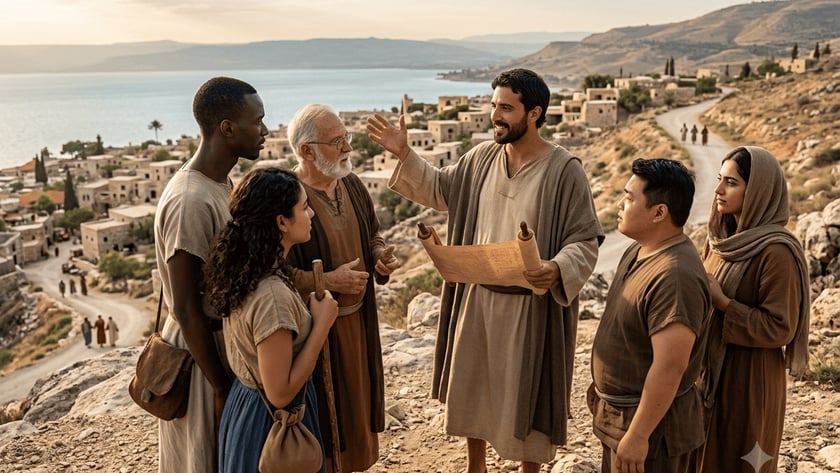
O que significa comissão na Bíblia
Na Bíblia, comissão é a delegação formal de autoridade que Deus entrega a alguém para executar uma missão específica em Seu nome. O uso mais conhecido da palavra refere-se à Grande Comissão: a ordem final dada por Jesus Cristo aos Seus apóstolos antes de subir aos céus, registrada no final dos evangelhos.
O termo não aparece na maioria das traduções tradicionais em português como um substantivo isolado, mas descreve o ato de comissionar — autorizar, incumbir e enviar representantes oficiais. Na Grande Comissão, Jesus não faz um convite opcional; Ele encarrega formalmente os Seus seguidores da continuidade da Sua obra na Terra.
Καὶ προσελθὼν ὁ Ἰησοῦς ἐλάλησεν αὐτοῖς λέγων· «Ἐδόθη μοι πᾶσα ἐξουσία ἐν οὐρανῷ καὶ ἐπὶ35 ℵA,W [99.5%] RP,HF,OC,CP,TR ¦ 1 της B,D [0.5%] [NU] γῆς. Πορευθέντες35 ℵA [95%] RP,HF,OC,CP ¦ 1 ουν B,W [5%] TR,NU ¦ νυν D μαθητεύσατε πάντα τὰ ἔθνη· βαπτίζοντες αὐτοὺς εἰς τὸ ὄνομα τοῦ Πατρός, καὶ τοῦ Υἱοῦ, καὶ τοῦ Ἁγίου Πνεύματος· διδάσκοντες αὐτοὺς τηρεῖν πάντα ὅσα ἐνετειλάμην ὑμῖν· καὶ ἰδού, ἐγὼ μεθ᾿ ὑμῶν εἰμι πάσας τὰς ἡμέρας, ἕως τῆς συντελείας τοῦ αἰῶνος.» Ἀμήν.35 [98.5%] RP,HF,OC,CP,TR ¦ --- ℵA,B,D,W [1.5%] NU,35 [50%] have, "published eight years after the ascension of Christ", to which all but f35 add, "in Jerusalem". For 50% of the MSS to have this information probably means that the tradition is ancient; and of course, I have demonstrated, to my own satisfaction at least, that f35 goes back at least to the 3rd century. If this information is correct, then Matthew was ‘published’ in 38/39 AD. The same sources have Mark published two years later (40/41) and Luke another five years later (45/46), while John was ‘published’ thirty-two years after the ascension, or 61/62 AD. Not only were the authors eyewitnesses of the events, but many others were still alive when the Gospels appeared. They could attest to the veracity of the accounts, but could also be the source of textual variants, adding tidbits here and there, or ‘correcting’ something that they remembered differently.,35 is based on the following fifty-one MSS—18, 35, 55, 128, 204, 246, 363, 386, 402, 479, 510, 547, 553, 586, 685, 757, 789, 824, 867, 897, 928, 1062, 1072, 1075, 1111, 1117, 1145, 1189, 1339, 1435, 1461, 1496, 1503, 1551, 1560, 1572, 1637, 1652, 1667, 1694, 1713, 2122, 2175, 2253, 2352, 2382, 2466, 2503, 2554, 2765 and I.2110—all of which I collated myself. I also took account of two collated by Scrivener (201, 480), but did not re-collate them. 2554 is a ‘perfect’ representative of f35 in Matthew, as it stands, while the exemplars of 1072, 1117, 1461, 1496, 1713 and I.2110 presumably were as well. Others come very close. The uniformity is impressive. Since these MSS come from all over the Mediterranean world (Sinai, Jerusalem, Patmos, Bucharest, Moscow, Constantinople, Lesbos, Leukosia, Aegean, Meteora, Kalavrita, Tirana, Mt. Athos [ten different monasteries], Athens, Corinth?, Bologna, Grottaferrata, Vatican, etc.) they are certainly representative of the family, giving us the precise family profile—it is reflected in the Text without exception.I have included six published editions in the apparatus—RP,HF,OC,CP,TR,NU. RP = Robinson-Pierpont (2005), HF = Hodges-Farstad, OC = the Greek Text of the Greek Orthodox Church (also used by other Orthodox Churches), CP = Complutensian Polyglot, TR = Textus Receptus, NU = N-A26/UBS3 (N-A27/UBS4 offer changes in the critical apparatus, not in the text; the text is still that of N-A26/UBS3). In the statements of evidence I have included the percentage of manuscript attestation for each variant within either ( ) or [ ]. I have used ( ) for the evidence taken from TuT, which I take to be reasonably precise. For the variant sets that are not covered there, I mainly depended on Legg (Novum Testamentum Graece Secundum Textum Westcotto-Hortianum. Evangelium Secundum Matthaeum [Ed. S.C.E. Legg, Oxonii: E. Typographeo Clarendoniano, 1940]). I occasionally supplemented from Swanson, Scrivener and von Soden—the percentages offered, I have used [ ] for these, are extrapolations based on a comparison of these sources. I venture to predict, if complete collations ever become available, that for any non-Byzantine variants listed with 5 to 1% support (in my apparatus) the margin of error should not exceed ±2%; for non-Byzantine variants listed with 10 to 6% support the margin of error should hardly exceed ±4%; where there is some division among the Byzantine witnesses the margin of error should rarely exceed ±15%—since my sources had collated a lower percentage of the extant MSS than ECM for the General Epistles, for example, my guesses as to percentages are more tentative than they were there, except that I guarantee the witness of f35. As an arbitrary decision, I have limited the citation of individual MSS to those dated to the 5th century or earlier. I use rell to indicate that the reading is supported by all other primary witnesses, and printed editions (of the six included in the apparatus), compared to the other reading.(Matthew 28:18-20)
O contexto da ordem no monte da Galileia
Os discípulos haviam passado pelo trauma da prisão, humilhação e crucificação de Jesus, seguido pela surpresa da ressurreição. Quando Jesus marcou o reencontro em um monte na Galileia, o grupo ainda oscilava entre a adoração e a dúvida.
A Galileia era uma região periférica, marcada pelo contato com povos gentios e pelo início do ministério de Jesus. Foi ali que Ele reafirmou a Sua posição definitiva: não mais apenas como o mestre itinerante, mas como o Senhor ressurreto que envia Seus representantes ao mundo.
Os quatro elementos do mandato de Jesus
O texto de Mateus 28:18-20 apresenta a estrutura completa dessa incumbência, dividida em quatro partes:
1. A autoridade que fundamenta o envio
Antes de emitir qualquer ordem, Jesus declara: "Toda a autoridade me foi dada no céu e na terra". Quem sai para cumprir a missão não vai em nome próprio, nem respaldado por força humana, mas debaixo da autoridade soberana de Cristo.
2. O verbo principal: fazer discípulos
No original grego, a única ordem imperativa central do trecho é fazer discípulos (matheteuo). As ações de "ir", "batizar" e "ensinar" funcionam como verbos auxiliares que mostram como essa ordem se cumpre na prática. O "ir" carrega o sentido de "enquanto vocês vão" pelo caminho comum da vida. Fazer discípulos vai além de registrar convertidos: significa formar pessoas que sigam o caráter e o ensino de Jesus.
3. Batismo e instrução prática
A integração de um novo discípulo exige dois passos contínuos:
Batizar: o sinal público de aliança e identificação com o Pai, o Filho e o Espírito Santo, inserindo a pessoa na comunidade de fé.
Ensinar a guardar: o ensino cristão visa a obediência prática aos mandamentos de Cristo, e não apenas o acúmulo de conhecimento bíblico teórico.
4. A promessa da presença contínua
A declaração termina com a garantia de sustento: "Eis que estou convosco todos os dias, até a consumação dos séculos". A tarefa é contínua e ultrapassa a capacidade humana, mas a comissão vem acompanhada da presença constante de Cristo com Seus enviados.
O alcance da Grande Comissão
A comissão entregue por Jesus em Mateus 28 não se restringiu aos onze apóstolos históricos nem se limita a pastores e missionários de carreira. O mandamento abrange todo cristão em seu ambiente cotidiano — na família, no trabalho e na comunidade. O chamado bíblico é viver intencionalmente, transmitindo a fé e formando seguidores de Jesus até a consumação dos tempos.
Este artigo te tocou? Faça uma oração!
+581 estão orando agora.
Junte-se à corrente de oração.